September 29th, 2026
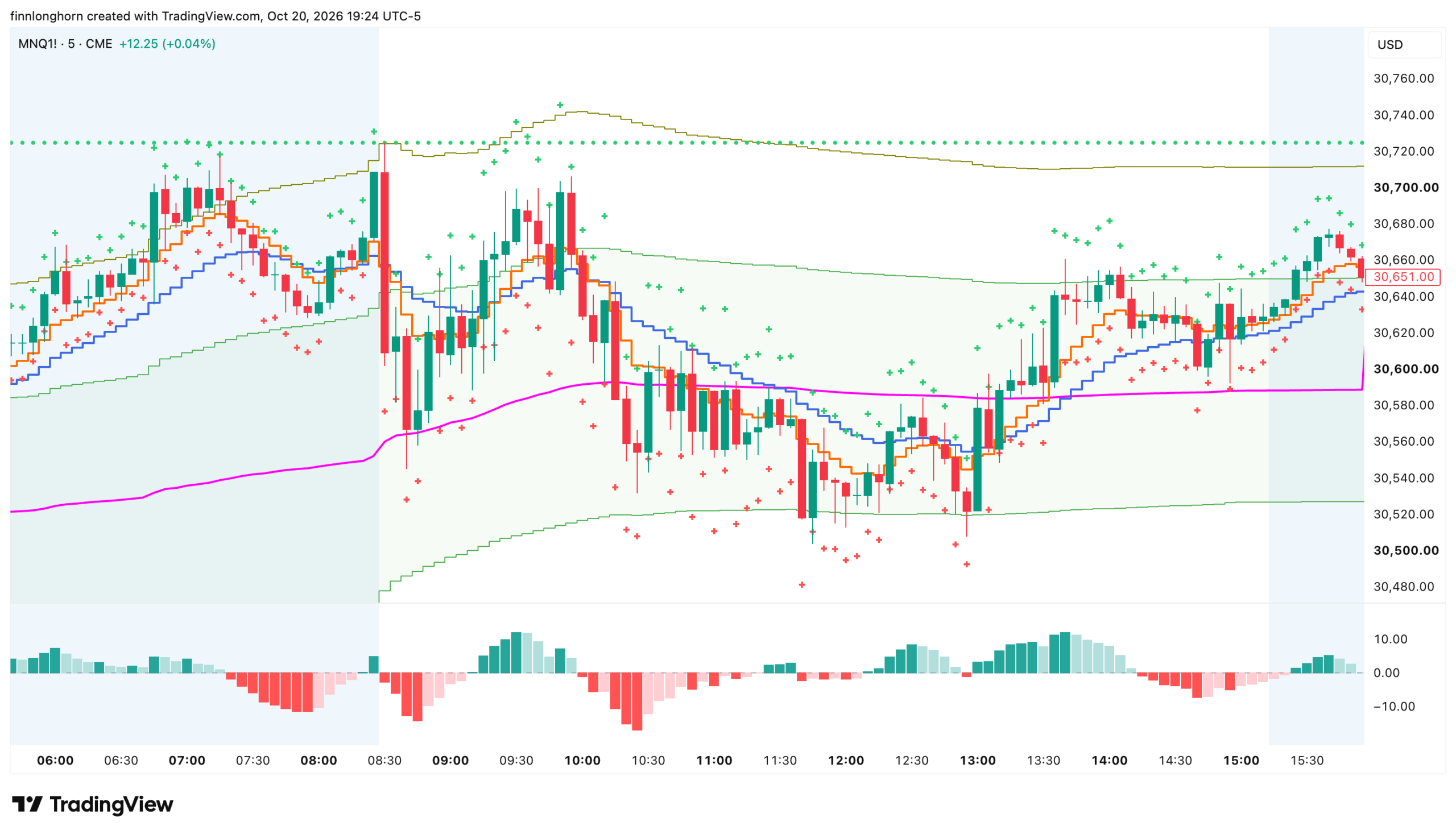
I actually remember this day, mainly because the price action was all over the place. Looking back, it was one of those sessions where neither strategy seemed to offer a perfect answer.
Under my older system, I probably would have stayed out of most of the market, which, in hindsight, might have been the better decision. The Fibonacci retracement levels would have filtered out several potential entries and likely kept me from taking unnecessary losses.
Under my newer VWAP-based strategy, however, this could have been a losing day. There were moments when the setup appeared to be telling me to enter, but the overall market wasn’t particularly convincing. MNQ and MES weren’t consistently moving together. At certain points, MES was heading lower while MNQ was moving higher. That kind of divergence made it difficult to establish a clear direction, and the price action was messy throughout much of the session.
This brings me back to something I’ve been trying to figure out throughout this entire trading journey: How much confirmation is enough, and when does too much confirmation actually hurt your strategy?
The Fibonacci retracement system has its advantages. On days like this, it can keep me out of questionable trades, especially when price is moving through the middle of a range without a clear direction. But I’ve also seen the opposite happen. On strong trending days, those same Fibonacci restrictions can prevent me from entering perfectly reasonable trades that go on to produce substantial profits.
And that’s the frustrating part. A filter that saves you money one day can cost you an opportunity the next.
The newer strategy is designed to capture those stronger directional moves, particularly when price breaks beyond the first VWAP standard deviation band. But that also means accepting that some setups will fail. Not every move outside a VWAP band is going to turn into a sustained trend, especially when the broader market is sending conflicting signals.
I honestly don’t remember exactly what trades I took this day, so I’m not going to pretend I know the outcome. Looking at the charts now, though, I suspect this could easily have been a losing session under the newer rules.
And that’s okay.
One thing I’m learning is that a strategy doesn’t have to win every day to be profitable over time. There will always be days when the market simply doesn’t cooperate. The important thing is understanding whether a loss comes from following a valid setup or from forcing a trade that never really met the rules.
I also don’t want to fall into the trap of constantly changing strategies based on what would have worked on a particular day. It’s easy to look backward and identify the filter that would have saved a loss or the indicator that would have caught a big move. But I need a system that works consistently across hundreds of trades, not one that’s perfectly optimized for yesterday’s chart.
Ultimately, September 29 was just a sloppy trading day. The lack of alignment between MNQ and MES, the inconsistent direction, and the potential for false signals made it a difficult environment.
The lesson from Day 79: Every trading filter comes with a trade-off. Fibonacci levels can help keep me out of bad trades, but they can also prevent good ones. My goal isn’t to build a strategy that avoids every loss. It’s to find the right balance between protecting my capital and allowing profitable opportunities to develop.
Sometimes the best trade is no trade at all. The challenge is knowing that before the market proves it to you.

Day 79 Travel Poster
Total Profit: $
MNQ Chart