October 16th, 2026
Another day, another frustrating experience. This week has been a difficult one, not necessarily because my strategy doesn’t work, but because I’m still trying to figure out how to execute it consistently without overcomplicating things.
Today was a perfect example of the problem I’ve been running into with trying to align the MNQ and MES while using MACD as a confirmation indicator.
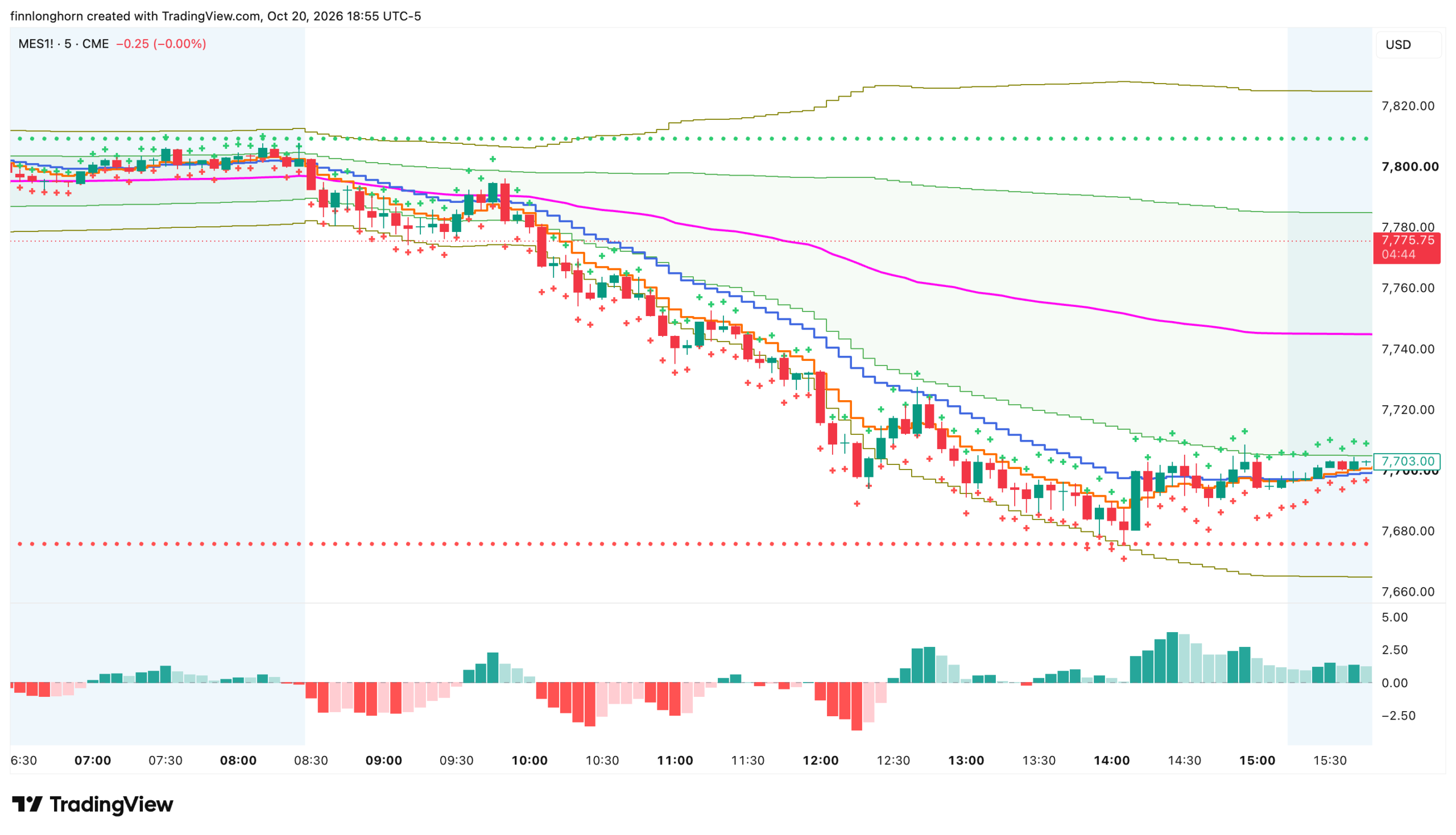
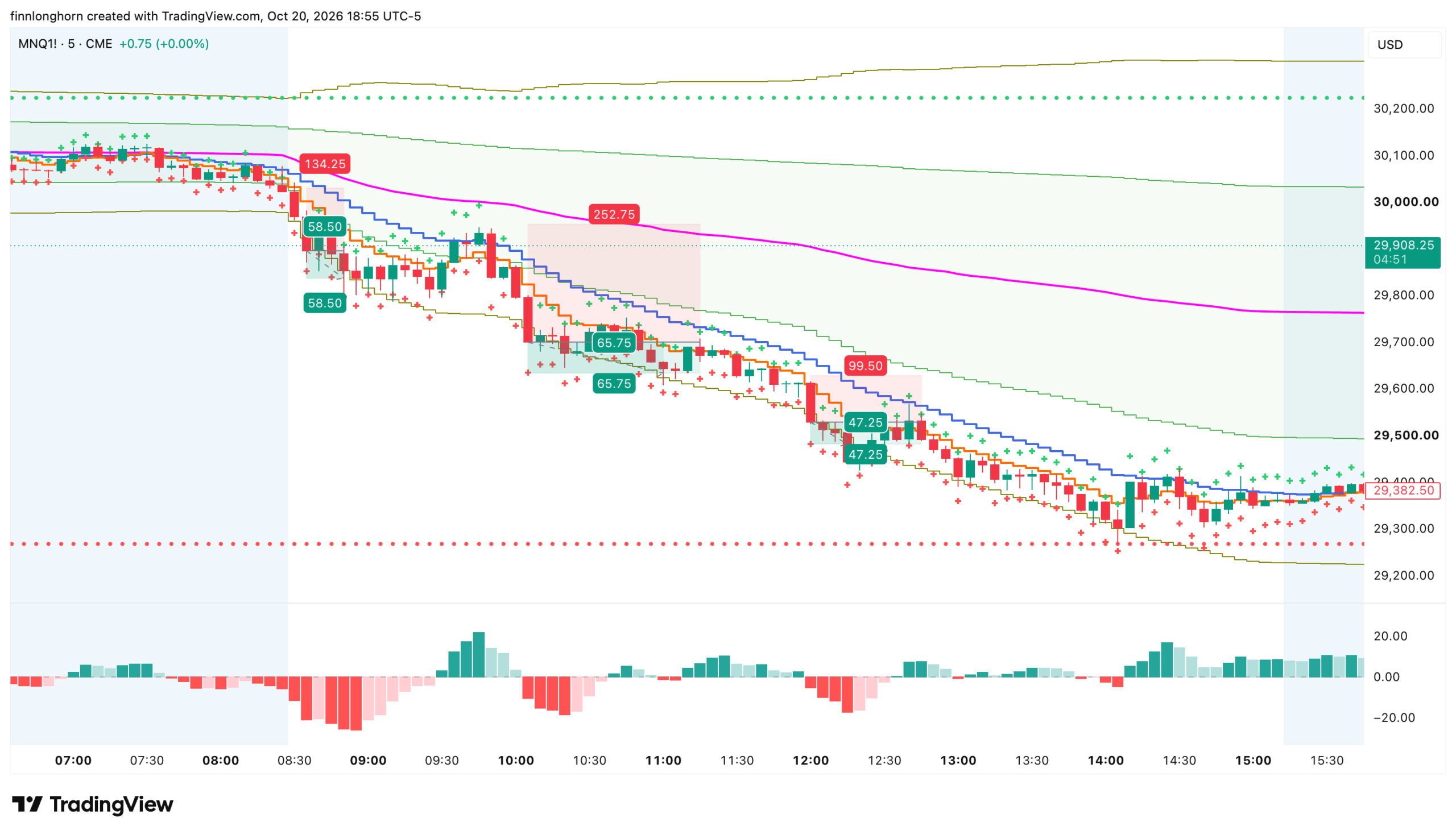
The market was in a clear downtrend, which should have been an ideal trading environment for my strategy. I actually like trend days. They tend to offer some of the best opportunities because price moves consistently in one direction, and there’s often more room for trades to develop and reach their targets.
But that’s exactly where my current system started falling apart.
The Problem with MACD on Trend Days
I’ve been using MACD alongside the MNQ and MES to confirm my entries. In theory, it makes sense. I want both markets moving in the same direction, with momentum supporting the trade. The idea is to avoid unnecessary losses and stay out of choppy conditions.
And to be fair, MACD does help with that.
The problem is that MACD is a lagging indicator. On strong trend days, by the time everything lines up and gives me confirmation, a significant portion of the move can already be over.
That creates another problem: Am I supposed to enter the trade now, or has price already moved too far?
That’s the question I kept running into today.
I would see a potential entry on MNQ, but MES or MACD wouldn’t quite confirm it. Then, by the time everything aligned, the market had already moved considerably. At that point, entering felt like chasing price rather than following a well-defined setup.
And that’s where the indecision starts.

Day 91 Travel Poster
When Too Much Confirmation Becomes a Problem
There’s a balance between being patient and making a system so restrictive that you miss the very opportunities it’s designed to capture.
I think that’s what happened this week.
I was so focused on getting MNQ, MES, and MACD to line up perfectly that I was constantly questioning whether I should be entering trades at all.
Sometimes the setup looked good on MNQ, but MES was already extended. Other times, MACD was late to confirm a move that was clearly underway.
Instead of giving me confidence, the additional confirmation was creating hesitation.
And on a strong downtrend day like today, that hesitation can make a huge difference.
The market doesn’t wait for every indicator to catch up.
Why I’m Changing My Approach
I’m not going to break down every individual trade today because I think the bigger issue is more important than any single entry or exit.
This wasn’t about one bad trade. It was about recognizing a weakness in how I was applying my strategy.
I’ve spent a lot of time backtesting and refining my approach, and I still believe that trading outside the one-standard-deviation VWAP bands gives me a solid framework.
The problem isn’t necessarily the overall strategy. It’s the additional conditions I’ve been using to confirm entries.
MACD can be useful when the market is choppy, but it can also keep me out of strong trends or give me signals so late that the risk-to-reward opportunity is no longer attractive.
I need a system that allows me to participate in those trends without constantly second-guessing whether the move has already gone too far.
That’s why I’m making changes for Monday.
I want to place more emphasis on price action, the relationship between the 8 and 20 EMAs, and where price is trading relative to VWAP. I’ll still use MES as confirmation of the broader market direction, but I don’t want to require every indicator to align perfectly before making a decision.
The goal is to make the rules more mechanical and less dependent on interpretation.
A Frustrating End to the Week
Looking back, this entire week was frustrating because there were opportunities to perform considerably better.
I’ve said that before, and frankly, I’m getting tired of saying it.
But I also have to recognize that there’s a difference between missing trades because I’m afraid to enter and missing trades because my rules are giving me conflicting signals.
This week felt like a combination of both.
There were moments when I hesitated, but there were also moments when the system itself made it difficult to know what the correct decision should have been.
That’s something I need to fix.
The encouraging part is that I think I’m getting closer to understanding what works for me. The VWAP framework still makes sense, and I’ve seen enough through backtesting to believe it’s worth continuing to develop. Now I need to simplify the execution and test whether those changes actually improve the results.
The biggest lesson from Day 91 is that more confirmation doesn’t always mean a better trade. Sometimes it just means a later entry.
And if there’s one thing this week has taught me, it’s that I need a strategy that tells me what to do when the opportunity is happening, not after it’s already passed.
Monday will be another opportunity to put that into practice.
Total Profit: $53.80
MNQ Chart
MES Chart